
 Retail Customer Experience.com has a new article by Graeme Spicer entitled “Digital Displays in Retail Environments Coming of Age”. The article talks about Walmarts recently refreshed in-store video network (aka Smart Network) and shares some data on the success of advertisements on the network.
I’ve seen similar Walmart data before, but always in private meetings, so now that the data is public I can comment… Here is why you shouldn’t believe it.
Contrary to Spicer’s article, Digital Merchandising is already widely used in retail merchandising. But the majority of deployments are NOT delivering paid ads. The video based displays are used to enhance shopping experiences, communicate complicated value propositions, and drive incremental sales.
Retailers make money by selling products and services for a profit. Not by capturing an audience to deliver paid advertisements to. Yes, retailers do try and get their supply chain partners to share in the cost of operating the store through the use of co-op advertising, slotting fees, merchandising accrual systems, etc… But at the end of the day, retailers don’t want promotions that merely shift sales from one brand to another, they want great experiences that drive incremental sales.
Walmart has a major initiative underway called Project Impact. The goals are to focus on the most strategic product categories and reduce their efforts in less important ones. They are also trying to dramatically reduce store clutter, and improve the shopping experience. Project Impact is being implemented in the form of major remodels to 1000’s of stores.
Because of Project Impact, there is now less shelf space and fewer promotional opportunities available to non-strategic brands. If you’re one of these brands, you are at risk for getting a smaller piece of the pie.
So because Walmart is offering viewer promotional opportunities, won’t they generate less co-op dollars? Not if they charge more for each opportunity… and that’s where the Walmart Smart Network (aka Walmart TV 2.0) comes in!
For the brands that still have shelf space at Walmart, you can now buy a promotional slot on the Smart Network (that includes promotional content on a digital merchandising system and premium product placement on a Walmart endcap).
The Walmart Smart Network actually has three different types of digital signage.
| 1. Welcome Signs – 57” LCDs w/o audio that hang over the front doors of the store and are (potentially) seen by all shoppers as they enter. Typically running 5 second spots. 200 million people go by these signs weekly (106 million people watched the superbowl where ads sold for $2.6M). |  |
| 2. Category Signs – 57” LCD signs w/ option for audio that hang in strategic departments (Health Grocery, Electronics). These signs are sometimes mounted in landscape and other times in portrait. Typically running 10 second sports. | 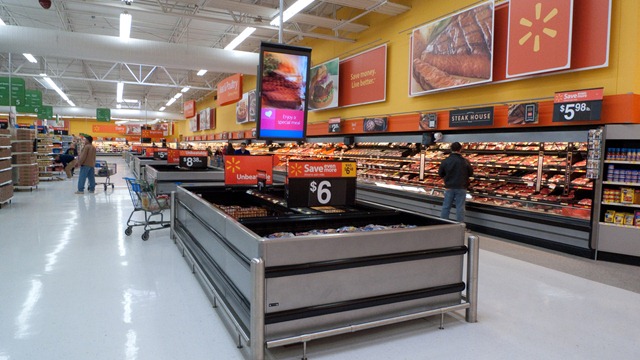 |
| 3. Digital Endcaps – that include a smaller portrait format display with product specific content and includes product placement on end-cap. Screens appear touch-capable although I haven’t seen an interactive one yet. You’ve got to wonder how much the digital sign is helping shoppers with the $0.48 ramen noodles. | 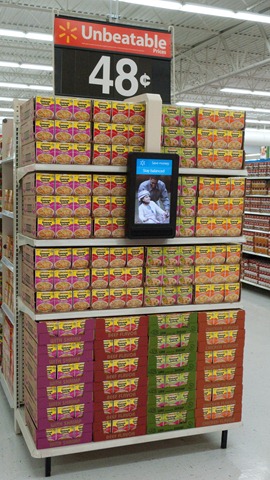 |
Walmart has a team of people that sell these new SmartNetwork promotional opportunities and they are more expensive than brands are accustomed to paying for in-store co-op. Those Ad-Sales people need to demonstrate a good return on investment for the brands. And that’s why Walmart has published data on the efficacy of the SmartNetwork, to sell ads, not out of some sort of altruistic gift to the digital signage community.
Walmart hired Candance Adams a very credible Customer Insight exec with a PhD, and she partnered with DS-IQ which is full of ex-Microsoft rocket-scientists. So I’m sure the research methodology is very legitimate. But here is the rub… the raw data get’s interpreted by people tasked with ad sales, and it’s there output that Walmart publishes (don’t we all know better than to trust ad men?).
So when Walmart says that a food item that buys a spot on their network get’s a 13 percent lift in sales, or a health/beauty product gets a 28 percent. What they don’t point out is that in their program is not just a spot on a digital sign, but also a product placement on a scarce end-cap! How much of that 28% lift is a result of the end-cap vs. the digital component? Walmart doesn’t say and there is no (published) DS-IQ study on the sales lift of the end-cap w/o the sign. When the SmartNetwork was launched, Stephen Quinn the CMO at Walmart said the goal was a 30% lift for the endcap products, which he said would typically result in a 5% lift to the entire category the product was in. As you can see, Walmart now says that even the most successful product is not achieving that goal. Further, Walmart doesn’t even try to claim to that the Category signs or the Welcome sign have a measurable effect on sales of a particular product.
The bottom line is that the Smart Network is all about keeping Walmart’s co-op revenue flowing in, while reducing the visual clutter and making Walmart a more pleasant place to shop. It’s a great strategy for Walmart but it’s far from evidence that digital signage advertisements drive retail sales.
I’d love to hear from Brand Managers that have bought into the program (even privately). What are you’re thoughts?
Update: It appears Walmart may be re-thinking project impact. Also, you can find more photo’s at http://photos.retailgeek.wpengine.com/Retail/Project-Impact/.

I know what you mean about not trusting numbers. I’ve gathered and consolidated merchandising data in the past. The question was never, “What does the data say?” The question was always, “What do we want the data to represent?”
The coming of age for this type of in-store fixture/media/device is here. Whether or not the numbers are accurate to me, is irrelevant. Just like the web in 94, it has taken a little time to figure out how to make something like this work. With the arrival of LCD touch screens, mobile devices, QR codes, Twitter, Facebook, and a host of other cool inventions we can finally make this work right.
Old agency thinking is not going to work here. It’s going to take the collaboration of good strategy coupled with the digital expertise that only comes from companies that truly understand how to harness today’s digital tools and toys.
While your article makes some good points on the transition of merchandising programs, it’s provocative scream is really “show ME the data”. You had me right up till your presentation of distrust for the numbers.
Every new media (and approach) is validated – with real data points – against other spending/investment options, and real data always has the benefit of a control scenario, which serves as the basis of comparison (i.e. 13% more) and therein, validation.
Dynamic place-based media has been consistently delivering sales lift (along with other key value points) for many years.. so the proposition that the numbers are fudged to sell the medium is just not on. In fact, the numbers, accurate and as precise as cost-justifiable, continue to sell it.
Please keep us posted in this area of in-store media application and efficacy.
This article vocalizes what hit me in the face when I first read “Digital Displays in Retail Environments Coming of Age.” No end cap data without a screen was given. The last thing a digital signage company should do is react on numbers in someone’s ad sales pitch.
While I would agree that digital signage has a great future , I wouldn’t be doing my job if I didn’t comment on Shawn Hall’s response.
Accurate numbers should be relevant to anyone in our industry so that we can properly gauge whether or not we’re going in the right direction as a digital signage provider. Otherwise, we would let people like these “ad-guys” pee on our leg and be OK with it when they tell us it’s raining.
Just because you think or blindly agree with something doesn’t mean it’s true.
If I told our clients that digital signage can provide them with a 75% sales lift, our clients would know better. Keeping the mindset that false results are irrelevant would quickly forfeit our credibility.
Well done Jason! For the last few years it feels like I’ve been talking to myself.. until I read this article.
Andrew Hoffman
Vice President
Noventri
20940 Twin Springs Dr.
Smithsburg, MD 21783-1510 USA
800-359-1858
301-790-0103
Fax: 301-790-0173
[email protected]
Skype ID: Spec-Comm
http://www.noventri.com
http://www.noventri.com/eco
http://www.noventri.com/forum
http://blog.noventri.com/
Hey Lyle,
Thanks for the note, but help me understand your criticism a bit better…
As a shopper marketer I’ve been doing matched panel tests in retail stores for over 20 years. I’ve done a number of tests of various digital merchandising tools that showed favorable efficacy, and others in which the digital display failed to provide a compelling ROI. Those results have all led me to conclude that Digital Merchandising is simply another tool in the shopper marketing arsenal, it’s the exact right tool for some merchandising challenges, and it’s certainly wrong for many others.
That being said. Doing A-B tests in retail stores is dicey. It’s very difficult to control variables in a live retail environment, and it’s virtually impossible to get statistically valid parallel traffic splitting, so we’re usually forced to use less accurate serial traffic splitting to do A-B tests. For that reason, Walmart and other retailers are migrating to simulated shopping environments for their serious A-B testing.
Walmart certainly knows how to test concepts, and they have employed plenty of credible shopper insight scientists to design and conduct their tests, but none of those scientists have put their name anywhere near the marketing claims made by the advertising sales team that published the numbers referenced in my article (or the new equally unbelievable numbers released at NRF last week).
By Walmarts own admission, the sales lift they quote is the result of running a digital merchandising spot in conjunction with moving the promoted product from an in-aisle location to an end-cap. Walmart doesn’t provide any data about the sales lift that would result from moving the product to the end-cap without the digital merchandising spot. The data can’t be used to validate digital merchandising w/o eliminating the product relocation effect.
If you’re saying that there are a few published tests (and many unpublished tests) that show digital merchandising efficacy in some use-cases, then I certainly agree. If you’re saying that you believe Walmart’s data is evidence that digital merchandising is effective, then I humbly disagree with you.