
We Don’t Go Grocery Shopping Anymore
In 2015 I said, “We don’t ‘go’ shopping anymore. We are always shopping.” People nodded politely. Then they went back to planning store traffic around the Saturday trip.
So here are my receipts. Literally.
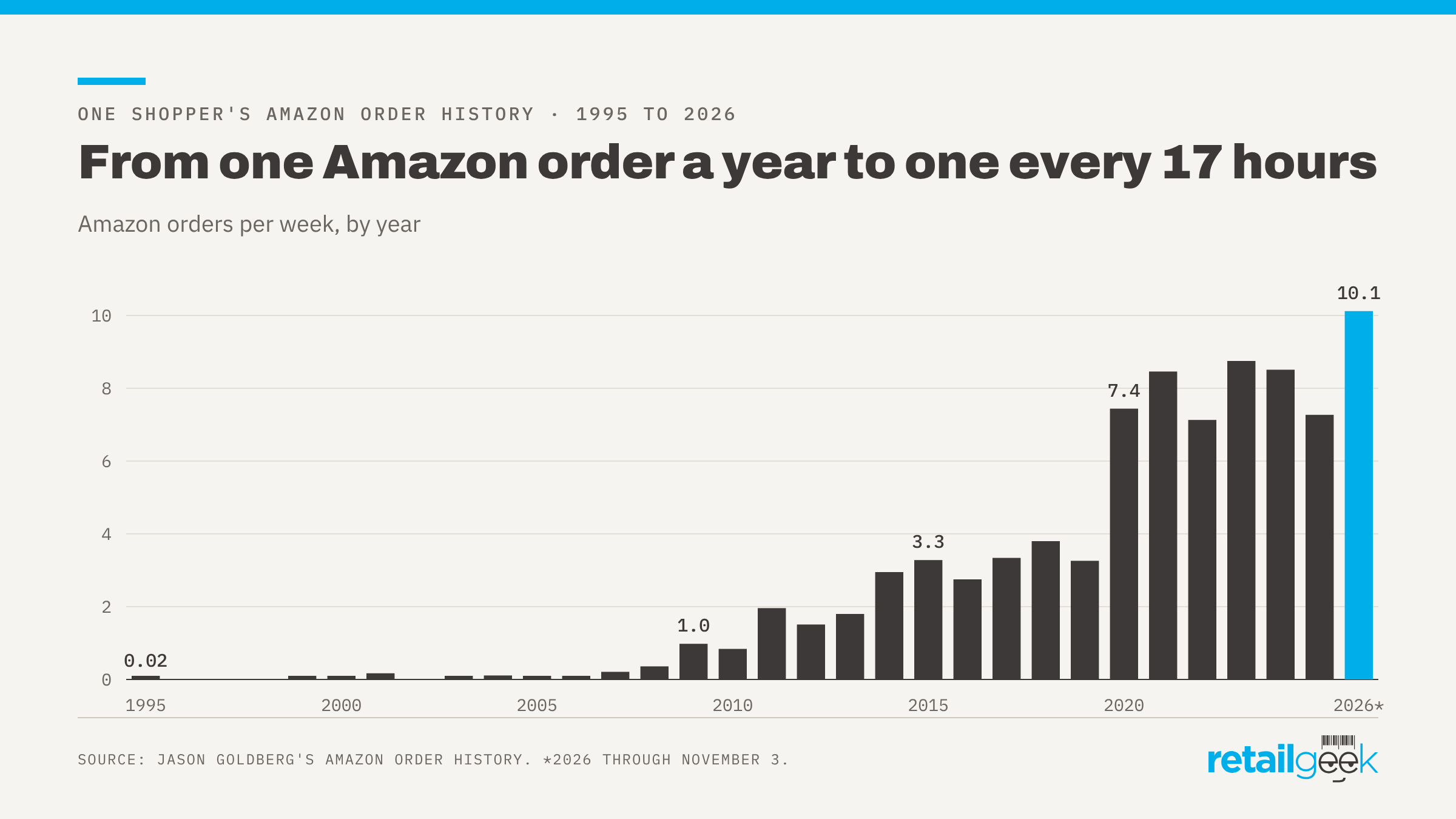
My own order history
I placed my first Amazon order in 1995. It was the only one I placed that year. For most of the next decade I averaged a few orders a year, and in 2002 I didn’t place any at all.
Then the curve bent:
- 2009 was the first year I averaged about one order a week (51 orders).
- 2015, the year I coined the phrase, I placed 171 orders. That’s one every 2.1 days.
- 2020 more than doubled 2019, from 170 orders to 389.
- In 2026, through November 3, I’ve placed 444 orders. That’s one every 17 hours, and a pace of roughly 525 for the year.
That’s one shopper, and it’s Amazon only. It also understates my household’s real behavior, because it doesn’t count the orders other people in my house place, or anything bought from Target, DoorDash or a brand’s own site. And we’re a Walmart+ family (now with a Sam’s Club membership, too), so this chart doesn’t even capture the majority of our groceries.
I know a single person’s order history is an anecdote, not a dataset. But it’s observed behavior, not a survey answer. Nobody asked me how often I planned to shop. The order log just recorded what I did.
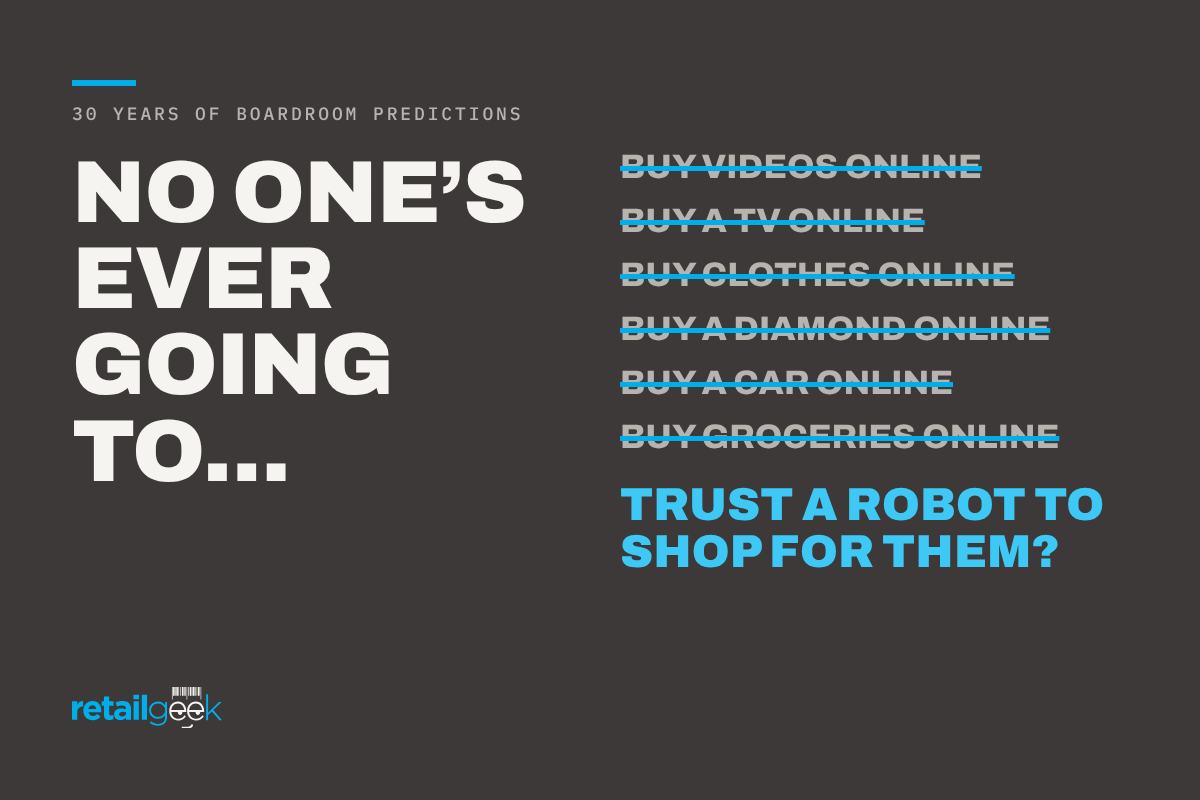
“No one’s ever going to buy that online”
Over 30 years I’ve sat in a lot of boardrooms where smart people explained why their category was safe. The list kept changing. The confidence never did.
- “No one will ever buy videos online.” Digital accounted for 92.4% of the $62.2 billion Americans spent on home entertainment in 2025, while disc sales fell to $870 million, according to the Digital Entertainment Group. (I launched e-commerce at Blockbuster, so I take this one personally.)
- “Fine, but no one will buy a TV online.” Online sales were 39.0% of Best Buy’s domestic revenue in the fourth quarter of fiscal 2026, according to the company’s earnings release. That’s the retailer with a big box in nearly every market, and it still doesn’t count the TVs sold on Amazon and Walmart.com.
- “Electronics, sure. But no one buys clothes online.” E-commerce will account for 37.9% of U.S. apparel, footwear and accessories sales in 2026, according to EMARKETER.
- “Jason, we sell beautiful things for your kitchen table. No one buys that online.” E-commerce was more than 65% of Williams-Sonoma’s revenue in fiscal 2025, according to CFO Jeff Howie on the company’s fourth-quarter call.
- “Who would ever buy an engagement diamond online?” Blue Nile built one of the biggest engagement ring businesses in the country by selling mostly online, which is a big part of why Signet, the largest mall jeweler, bought it in 2022.
- “No one’s ever going to buy a car online.” Tesla’s sales channels “currently include our website and a global network of company-owned stores,” and it has no independent dealer network, according to its 2025 10-K.
The fair counterpoint is that a lot of these sales still involve a store. People still (sometimes) test drive the Tesla. They look at the ring under the showroom lights. That’s true, and it’s why I care more about digitally influenced sales than about where the transaction lands. But the “no one will ever” crowd wasn’t arguing about channel mix. They were arguing that consumers would never change. Every one of them was wrong.
By now, anytime I hear “no one’s ever going to,” my spidey sense starts tingling.
Why my purchase behaviors changed
Nothing about my personality changed between 1995 and 2026. The friction did:
- Ordering got easier. When I started in e-commerce in the ’90s, the average online purchase took about 28 clicks. Now it takes one.
- Assortment got deeper. The endless aisle actually became endless.
- Prices got easier to compare, so the trip stopped being the way to get a good deal.
- Speed of delivery went from a week to a day to a few hours.
I still go to stores (and no one loves stores more than me). But I used to solve most problems by driving to the mall, the grocery store or the club store, and I batched my needs to make the trip worth it. Now, more often than not, I order what I need, when I need it, from whatever screen is closest. That’s what “always shopping” means. It isn’t more shopping. It’s shopping that has dissolved into the rest of the day.
Grocery is next
Grocery was supposed to be the exception. Perishables are hard, baskets are big, margins are thin, and people like to pick their own avocados. All of that is still true. But the speed problem is getting solved.
Walmart says it can reach about 95% of U.S. households in under three hours, up from 76% two years earlier, according to its third-quarter fiscal 2026 results. Its U.S. e-commerce sales grew 24% in the second quarter of fiscal 2027, and store-fulfilled delivery grew 40%, according to the company. And the business is now profitable, which was the thing skeptics said would never happen.
Amazon expanded same-day delivery of perishable groceries to more than 2,300 U.S. cities and towns by the end of 2025, and said its online perishable sales grew 30 times over that year. In 2026 it rolled out Amazon Now, 30-minute delivery of groceries and essentials from small neighborhood hubs, to dozens of U.S. cities. (Amazon also says customers who add fresh groceries shop about twice as often. That’s a correlation. The people who buy fresh online were probably already its most frequent shoppers.)
The money is moving, too. Online grocery sales grew more than 20% in the first half of 2026 while sales at food and beverage stores and general merchandise stores combined grew less than 2%, according to Brick Meets Click.
The casualty is the weekly stock-up trip. Nobody needs to predict the 72 items they’ll consume over the next seven days and haul them home in one exhausting trip when anything they run out of can show up in 30 minutes to four hours. We don’t go grocery shopping anymore. We are always grocery shopping.
That changes the economics for everyone built around the trip. Smaller, more frequent baskets mean fewer impulse buys at the endcap, fewer chances for a new brand to get discovered on the shelf, and a lot more value in being the default reorder.
The next “no one’s ever going to”
Here’s the one I hear constantly now: “Jason, no one’s ever going to trust the robot to make purchases for them.”
I’ll give the skeptics their best argument. Delegating a decision is different from changing a channel. Every shift above still had a human picking the product. Handing that choice to an agent means trusting it with your money and your taste, and a bad substitution on Tuesday’s dinner is more memorable than a hundred good ones. I also think agentic commerce will take longer than the hype suggests.
But we already delegate more than we admit. The robot already picks the music we listen to. Subscribe & Save picks the date. The grocery app picks the substitute. The default reorder button picks the brand. Delegation won’t start with engagement rings. It will start with paper towels, dish soap and the 30 items most households buy on repeat, exactly the items the weekly trip used to be built around.
Thirty years of “no one’s ever going to” makes me suspect this one ends the same way.
What to do first
- Sort your assortment into replenishment items and considered purchases. The replenishment items are the ones that move to always-on ordering first, and to agents after that.
- Stop planning around the trip. Measure purchase frequency and how often you’re the default reorder, not just basket size and store traffic.
What’s the “no one’s ever going to” you’re hearing in your boardroom right now?