
The Agentic Threat to Google and Amazon Ads Is Coming From Inside the House
Google and Amazon both reported slower ad growth last week, and my feed instantly filled with obituaries for the ad business. Agents are here, nobody sees ads anymore, sell your search budget.
I think that’s wrong on both counts. Amazon’s slowdown is mostly a calendar quirk. And whatever AI is doing to these ad businesses, it isn’t coming from Muse or ChatGPT shopping on your behalf. It’s coming from inside the house.
Amazon’s ad business is fine
Amazon moved Prime Day from July to June this year. That shifted the biggest ad week of the year from Q3 into Q2, which is why Q2 grew 26% and Q3 grew 11%. Comparing either quarter alone to last year tells you nothing.
Add them together and Amazon sold $39.4 billion of ads in Q2 and Q3, up 18% from a year ago. The same two quarters in 2025 grew about 23%.
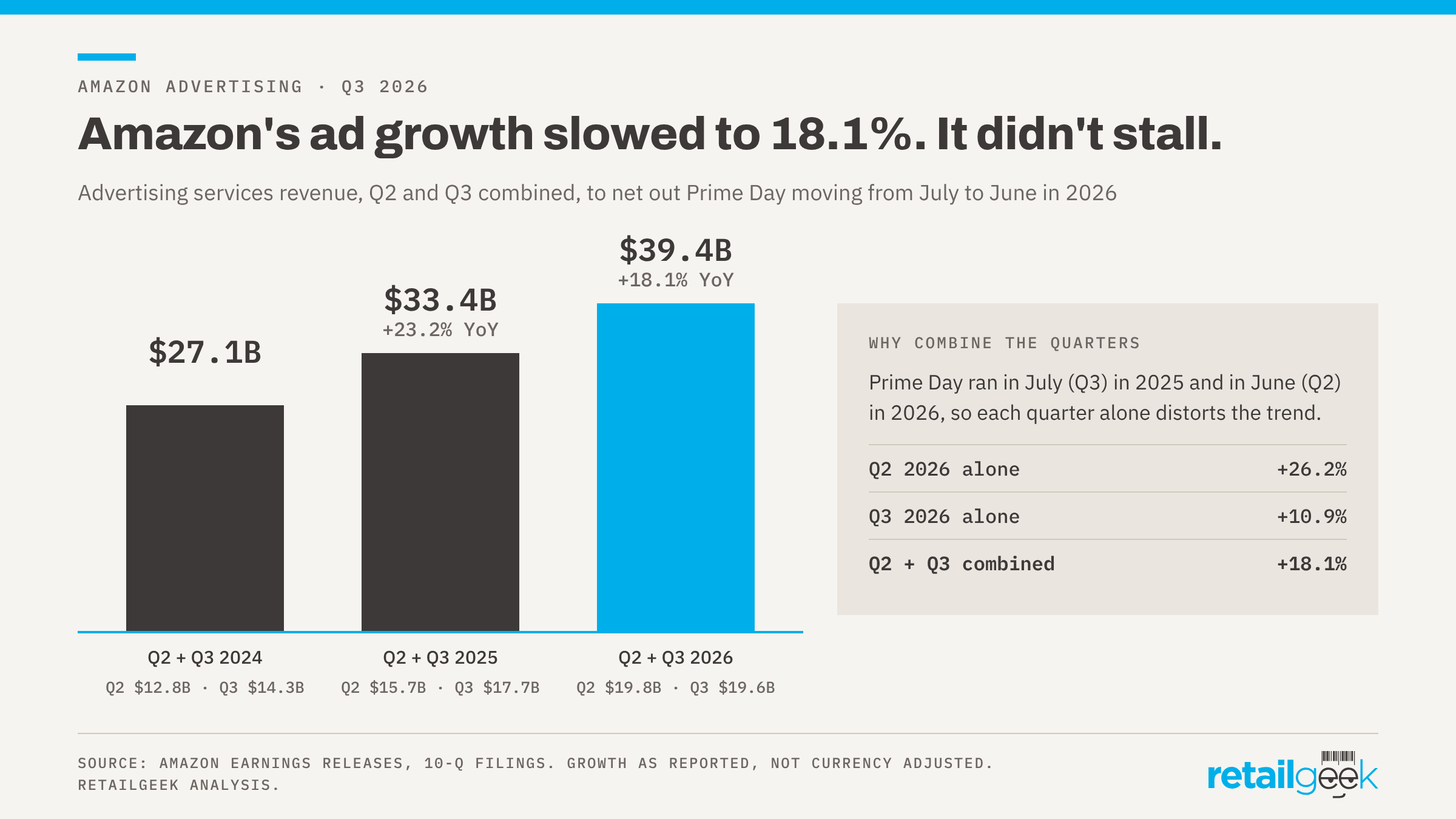
Is that a slowdown? Yes, and I’m not going to pretend otherwise. The Q4 guide is “high teens” against 22% last year, partly because Amazon is now lapping its first NBA season and last year’s sponsored search changes. But high-teens growth on a $68 billion ad business is not a business being killed by anything.
Outside agents barely show up in the data
Here’s what the companies actually said:
- Amazon: Andy Jassy said outside shopping agents aren’t a factor because “few customers are doing much shopping this way yet, as the experience is still not great.”
- DoorDash: On the call announcing the Instacart deal, management said third-party AI agents have produced several hundred orders. Total. Since launch.
- Amazon, again: It blocked Muse, is suing Perplexity, and has moved against OpenAI’s and Google’s agents. It’s hard for an agent to steal ad impressions from a store it can’t get into.
Yes, Amazon and DoorDash would both rather you keep opening their apps. Discount the quotes. They still line up with each other, and with every order log I’ve seen.
The real disruption is the agents they own
Now look at Google. Philipp Schindler said AI Mode query growth hurt search revenue “because of the lower monetization we were seeing in AI Mode.” Meanwhile, queries grew at their fastest rate in five years and paid clicks grew 8%.
Read that again. People are searching more than ever. More of that searching happens on a Google surface with fewer ads.
Amazon has the same dynamic, it just doesn’t say so. Alexa for Shopping had more than 400 million users in the last 12 months, and interactions grew 570%. Every shopper chatting with Alexa for Shopping is a shopper who isn’t scrolling past a wall of sponsored listings. Amazon doesn’t disclose that tradeoff, so this part is my inference. But it’s a far better suspect than a horizontal agent that’s sent DoorDash a few hundred orders.
So if agentic AI is denting Google and Amazon ads, it’s their own vertical agents doing it: AI Overviews, AI Mode and Gemini at Google, Alexa for Shopping at Amazon. That’s a very different problem from “the agents are coming.”
And it’s a problem they’ve solved before
Google waited two years to sell AdWords. Google Shopping was free until 2012. Amazon took 17 years to roll out Sponsored Products. Facebook told IPO investors in 2012 that it barely made money on mobile, and mobile was half its ad revenue by the end of 2013.
The playbook never changes. Give customers a lot of value first. Build the habit. Then add ads as people come to depend on the service and tolerate more of them. Both companies are already running it: Amazon gave away sponsored placements in its assistant before it started charging, and Google is scaling ads in AI Mode and AI Overviews right now.
Judging the long-term ad value of AI Mode by its first year is like judging mobile by Facebook’s 2012 S-1.
The data behind the panic is thin
A lot of the “agents are taking over” evidence doesn’t hold up when you open the hood.
- McKinsey’s new survey says 17% of U.S. AI users bought something inside an AI tool. The U.S. sample is about 1,000 people, “AI tool” includes Amazon’s own assistant, and it’s what people say they did, not what they did. Stated preference is not observed behavior.
- Adobe says AI traffic to retail sites is up 393%. Off a tiny base, from a company that sells AI optimization tools.
- HUMAN Security says retail gets more agentic traffic than any other industry. HUMAN sells bot management.
- Profound estimated Muse traffic from unverified bot requests and calls its own method a proxy. Profound sells AI visibility tools.
I’m not saying any of them is lying. I’m saying the methods are black boxes and every incentive points the same way. When the survey and DoorDash’s order log disagree, I’m going with the order log.
Someone still has to pay for the agents
Every one of these services needs a business model: subscriptions, ads, or a cut of each sale. We’ll see all three, mostly as hybrids. But I’m with Ben Thompson that ads are the model that wins at consumer scale. Retail margins can’t absorb another take rate, and most consumers won’t pay for software. “Ads” here just means a brand paying the agent’s owner for better placement: a sponsored prompt, an offer, a spot on the shortlist.
Thompson also makes the best case against me. He argues agents, not chatbots, are the real threat to Google and Amazon, because once the human leaves the loop, nobody sees the ads. In the long run he might be right about how ads change shape. But today the human is still in the loop almost everywhere, and the ad dollars will follow the decision wherever it goes.
What I might have wrong
If Amazon’s Q4 comes in well below high teens with no timing excuse, or if Google keeps adding ads to AI Mode and the gap between query growth and paid clicks doesn’t close, then the slowdown is structural and I’m too optimistic.
What to do first
- Don’t cut Google or Amazon search budgets because of the agent narrative.
- Test ads in AI Mode, AI Overviews and Alexa for Shopping while the auctions are thin. Early Sponsored Products buyers got cheap clicks for years.
- Treat outside agents as a product data project, not a media line, for now.
- Ask every agentic research vendor for its sample and methodology before it goes in a budget deck.
So here’s my question: has anyone actually seen measurable ad impressions or sales lost to a third-party agent? Or are we all just reading the same vendor charts?
Sources
- Amazon Q3 2026 ad revenue and Prime Day timing, PPC Land
- Amazon’s ad revenue growth decelerates, Marketing Dive
- Jassy on outside shopping agents and Alexa for Shopping, The Next Web
- Google’s AI overhaul of search hits snags as ad growth cools, Marketing Dive
- Alphabet Q3 2026: search ad growth slowed, queries did not
- Amazon is giving away Rufus ads for free (for now), The Drum
- Google Shopping’s transition to pay-for-play, TechCrunch (2012)
- Facebook now makes most of its money from mobile ads, Business Insider (2014)
- Who wins when AI does the shopping?, McKinsey